
Historic Record: Moroccan Ports Surpass 200 Million Tons
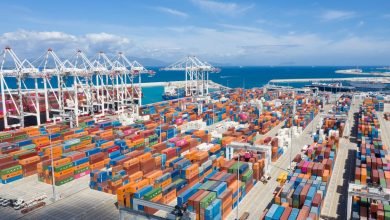
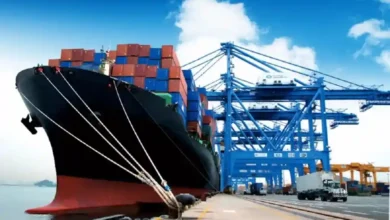
Moroccan ports have surpassed the milestone of 200 million tons for the first time in 2023. They recorded a positive trend in overall port traffic, which increased from 195 million tons in 2022 to 209.4 million tons in 2023, reflecting a growth of 7.4%. Domestic traffic accounted for 112.7 million tons, marking a rise of 2.3%, while transshipment reached 96.7 million tons, representing a growth of 14% compared to 2022.
The distribution of overall port traffic in 2023 is characterized by a predominance of transshipment activities, which accounted for 46.2%, followed by imports at 32.1%, exports at 17.2%, cabotage at 3.8%, and bunkering at 0.8%.
In terms of transshipment activities, the Tangier Med port complex has solidified its position as a major logistics hub in the Mediterranean basin, thanks to an increase in container transshipment volume (92.8 million tons/+13.7%) and hydrocarbons (3.7 million tons/+17.5%).
Imports for the year 2023 reached 67.2 million tons, marking a 1.9% increase compared to 2022. This change is primarily attributed to variations in the import traffic of: cereals (9.2 million tons/+3.9%), sulfur (6.5 million tons/+3.6%), hydrocarbons (11.9 million tons/-1.2%), and coal (10.5 million tons/-6.2%).
The volume of exports saw a 3.5% increase in 2023, totaling 36 million tons. This change is due to the growth in exports of fertilizers (11 million tons/+20.5%) and clinker (2 million tons/+21.7%), while there was a decline in the traffic of raw phosphate (4.4 million tons/-18.4%) and sulfuric acid (802 thousand tons/-38.7%).
As for Cabotage, Exchanges Between Moroccan Ports Increased…
Regarding cabotage, exchanges between Moroccan ports experienced a 2.7% increase compared to 2022, recording a volume of 7.9 million tons in 2023, primarily driven by the rise in container traffic (+13.8%) and hydrocarbons (+21.2%).
Bunkering of hydrocarbons saw a decrease of 8.2% compared to 2022, recording a volume of 1.7 million tons, benefiting vessels transiting through the Strait of Gibraltar.
The traffic of new vehicles increased by 16% in 2023, totaling 673,630 units, with 77% destined for export.
In terms of passenger traffic, Moroccan ports facilitated the transit of 4,785,223 passengers in 2023, representing a 39.1% increase compared to 2022, as part of the « Marhaba 2023 » operation. The ports of Nador, Tangier Med, and Tangier City accounted for over 98% of the total passenger traffic.
As for cruise activities, there was a significant recovery with a 91.9% increase, totaling 192,996 cruise passengers for the year 2023.
Additionally, the volume of landings of coastal and artisanal fishery products in 2023 experienced an 11% decrease, settling at 1.35 million tons.
Maritime traffic in Moroccan ports saw substantial growth in 2023, with the arrival of over 27,900 commercial vessels, marking a 16% increase compared to 2022.
Moroccan ports have surpassed the milestone of 200 million tons for the first time in 2023. They recorded a positive trend in overall port traffic, which increased from 195 million tons in 2022 to 209.4 million tons in 2023, reflecting a growth of 7.4%. Domestic traffic accounted for 112.7 million tons, marking a rise of 2.3%, while transshipment reached 96.7 million tons, representing a growth of 14% compared to 2022.
The distribution of overall port traffic in 2023 is characterized by a predominance of transshipment activities, which accounted for 46.2%, followed by imports at 32.1%, exports at 17.2%, cabotage at 3.8%, and bunkering at 0.8%.
Ports in the Maghreb
In terms of transshipment activities, the Tangier Med port complex has solidified its position as a major logistics hub in the Mediterranean basin, thanks to an increase in container transshipment volume (92.8 million tons/+13.7%) and hydrocarbons (3.7 million tons/+17.5%).
Imports for the year 2023 reached 67.2 million tons, marking a 1.9% increase compared to 2022. This change is primarily attributed to variations in the import traffic of: cereals (9.2 million tons/+3.9%), sulfur (6.5 million tons/+3.6%), hydrocarbons (11.9 million tons/-1.2%), and coal (10.5 million tons/-6.2%).
As for Cabotage, Exchanges Between the…
The volume of exports saw a 3.5% increase in 2023, totaling 36 million tons. This change is due to the growth in exports of fertilizers (11 million tons/+20.5%) and clinker (2 million tons/+21.7%), while there was a decline in the traffic of raw phosphate (4.4 million tons/-18.4%) and sulfuric acid (802 thousand tons/-38.7%).
As for Cabotage, Exchanges Between Moroccan Ports Increased…
Moroccan ports have surpassed the…
Regarding cabotage, exchanges between Moroccan ports experienced a 2.7% increase compared to 2022, recording a volume of 7.9 million tons in 2023, primarily driven by the rise in container traffic (+13.8%) and hydrocarbons (+21.2%).
Bunkering of hydrocarbons saw a decrease of 8.2% compared to 2022, recording a volume of 1.7 million tons, benefiting vessels transiting through the Strait of Gibraltar.
Additionally, the volume of…
The traffic of new vehicles increased by 16% in 2023, totaling 673,630 units, with 77% destined for export.
In terms of passenger traffic, Moroccan ports facilitated the transit of 4,785,223 passengers in 2023, representing a 39.1% increase compared to 2022, as part of the « Marhaba 2023 » operation. The ports of Nador, Tangier Med, and Tangier City accounted for over 98% of the total passenger traffic.
As for cruise activities, there was a significant recovery with a 91.9% increase, totaling 192,996 cruise passengers for the year 2023.
Additionally, the volume of landings of coastal and artisanal fishery products in 2023 experienced an 11% decrease, settling at 1.35 million tons.
Maritime traffic in Moroccan ports saw substantial growth in 2023, with the arrival of over 27,900 commercial vessels, marking a 16% increase compared to 2022.